Friday, November 19, 2010

DIWALI AND EVERYTHING ABOUT IT

The sound of the firecrackers and the sparkling of the rockets assure me that I am not too late in writing something about Deepavali (This is actually a lie – As I post this, it is 2 weeks since the festivities). Every Indian festival in the past 2 years has presented me with an opportunity to wield the pen (the keyboard rather) explaining it, its origin et al. However, I have been consistent in my inconsistency. But, ‘Der Aaye Durust Aaye’; finally I have threatened myself with a ‘Now or Never’ clause and have come down to the real business. So, find below some information about this august festival celebrated usually in October or November, which more than anyone else fascinates children and students with the lure of sweets, crackers and above all, holidays!

 *I should actually have started with Ganesh Chaturthi. Just as any new venture is begun by invoking Lord Ganesh (the reasons for which are almost unknown, except for a boon he gains for Lord Brahma, I think), I should have been careful enough not to breach the protocol. Yet, by appeasing most of the other Gods, I hope to avoid any misfortune to the viewership of this post.

To understand anything, we should start with the term itself. Deepavali, also known as Diwali, literally means a row of lights, or lamps specifically. This term emerges from the celebration of Lord Ram’s return to Ayodhya, after his 14 years exile, by lighting of lamps and decoration with flowers and garlands. At least this is what I remember having been told in school. However, there is a lot more to Diwali than this. So much so that some of the ‘Brothers and Sisters’ from our school-time pledge celebrate this amazing festival for different reasons altogether. Let us explore the many aspects of Diwali and what we do about them…

Diwali is a 5 days festival, each of which is not celebrated by everyone. It starts on the 13th Lunar Day of the waning Moon (Krishna Paksha) in the month of Karthik (Sanskrit/Hindi) or Ippasi (Tamil), depending on which calendar one refers to (more on this discrepancy later).

a. Day 1 – Dhanteras or Dhantrayodashi meaning ‘Wealth – 13th day’ finds its roots in Lord Dhanvantri – the God of Wealth or Physician of the Gods – an incarnation of Lord Vishnu. During the Samudra Manthan (Ocean Churning), Lord Dhanvantri emerges (in the end) carrying a pot of nectar, which was a very important resultant of the process.

It is this emergence of the Lord that has translated into the celebration of this day. Contemporary practice, in West and North India, however prescribes that Gold & Jewelry be purchased on this day and that Goddess Lakshmi be worshipped for wealthy operation of business. It is interesting to note the correlation of Dhan with both Health and Wealth. Perhaps the ancient Indians were well aware of the adage ‘Health is Wealth’.

Another story relating to this day, in a more direct fashion, is that of a lady protecting her husband’s (presumably the young son of Mountain King Lord Hima) life. She blocked the entrance to their house with a pile of dazzling jewelry and lit up house with bright lamps, which repelled Lord Yama from entering and taking her husband’s life. This has supposedly led the day to also be known as ‘Yamadeepdaan’.

I also remember something related to King Kuber, the Lord of Wealth, to Dhanteras. But as I am not very certain about it, I better skip it.

b. Day 2 – Naraka Chaturdashi (Netherworld – 14th day) is one of the very few festivals named not after the vanquisher, but the vanquished.
It commemorates the killing of Naraka-Asura (Netherworld – Demon) at the hands of Satyabhama, consort of Lord Krishna. Narakasura, son of Bhoomi-Devi (Goddess Earth) had taken control over the three worlds and had imprisoned many (all?) women, including Goddess Earth herself. In accordance to a boon, he could be killed only by his mother. As explained in an earlier post, Satyabhama is the incarnation of Goddess Earth and hence Lord Krishna arranges the death of Narakasura at the hands of Satyabhama, who accompanies the Lord on his mount, Garuda, to attack the demon. Bhoomidevi, when freed, requests Lord Krishna to ensure that this day is remembered as the victory of Good upon Evil et al, owing to which we celebrate this day.

A chiefly South Indian festival, this day is observed by an early morning rise, followed by Ganga Snanam – Symbolic bathing in Ganga – and a visit to Krishna temples. The concept of bursting crackers in the morning is not original to this day. It is borrowed from the next phase of Diwali, the main one in West, North and East India.


c. Day 3 – Diwali and Lakshmi Puja, though technically different occasions, are celebrated almost hand in hand. The story behind one is quite straight forward, and the other almost unknown or mired in duplicity. Diwali, as explained earlier, is celebrated over the return of Lord Rama and Co. to Ayodhya. Rows of Lamps are lit, crackers are burst, and sweets are prepared & exchanged. Quite easy to understand and no confusion at all.

But why Lakshmi Puja? I don’t think it has much to do with Mother Sita, incarnation of Lakshmi Devi, accompanying Lord Ram and hence this is not linked to the Diwali we understand so well. My limited understanding reveals to me two possible reasons behind this celebration. One is again related to the Samudra Manthan we discussed a while ago. For some reason, Goddess Lakshmi got angry with everyone and hid herself in Sagara, the grand daddy of oceans. Now mind you, it is not that only Lord Vishnu or the Devas were concerned over her absence. The world plunged into darkness, as even the Asuras were distraught over Lakshmi’s departure. What??? Shouldn’t the Asuras have been delighted over the plight of the Devas? But how could that be, when they regarded Goddess Lakshmi as their own sister!!! An amazing twist isn’t it, but something not very difficult to comprehend.

Goddess Lakshmi symbolizes Wealth and Prosperity and hence was dear to one and all. And she too, though closest to Lord Vishnu, patronized anyone who regarded her with importance. The Asuras, dwelling beneath the Earth, were amassers of wealth and quite possessive of the Goddess. And hence, if I am not mistaken, the Asuras agreed to the Ocean Churning process to extract Goddess Lakshmi. Of course, they wanted the Nectar as well. But I think Goddess Lakshmi was the reason they partook in this exercise. The Devas on the other hand desperately were in need of the Nectar, to counter the Sanjeevani secret (by which the dead could be revived) possessed by the Asura preceptor, Shukracharya.

Nonetheless, during the churning, Goddess Lakshmi emerged from the Ocean in the form of Shree (contrary to the popular belief, Shree is not Lord Vishnu; the red herring being the salutation given to Gentlemen in Hindi) and she immediately identified Lord Vishnu as her consort. IT IS THIS EMERGENCE OF GODDESS LAKSHMI, WHICH IS CELEBRATED AS LAKSHMI PUJA. I really cannot cut the long story short, can I? But this is only a speculation, at least for me, as I know of one more reason behind this Puja.

Remember Onam, Maharaja Bali, Vamanavatar? Bali, after graciously losing his empire to Lord Vishnu, asked for a boon – that the Lord be his Door Keeper in the Nether World (not driven by revenge or any malicious feeling, but a pious request to be near the Lord always). The Lord had no option but to agree. So, he left Vaikuntha and was separated from Goddess Lakshmi. After some time the Goddess became restless and could no longer stay away from her and the world’s Lord. So, Lord Shiva and Lord Brahma agreed to help; they offered to take Lord Vishnu’s place as the Door Keeper(s) in Patala-Loka. So, upon Lord Vishnu’s return to Vaikuntha, Goddess Lakshmi was jubilant, ecstatic. To celebrate this day, Lakshmi Pooja is conducted.

Shops are decorated, Homes are beautified and new clothes are worn to invite Lakshmi Devi and with her luck, money and pleasure. In any case, one doesn’t need an occasion to celebrate wealth and prosperity.

d. Day 4 – Govardhana Pooja and Bali Pratipadya find their roots in stories from two incarnations of Lord Vishnu – Sri Krishna and Vamana Avatar.
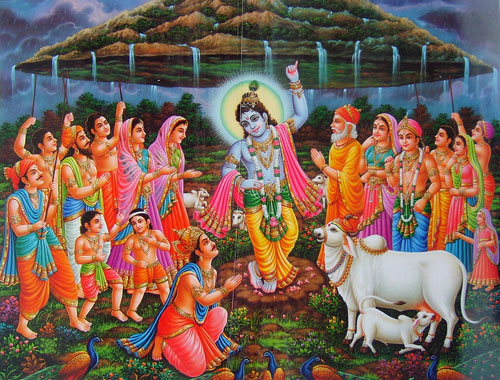
Govardhana Pooja is directed towards Mount Govardhan, near the town of Vrindavan in Uttar Pradesh. Indra, the Rain God, was extremely proud of his worship by the villagers of Vrindavan. Bala-Krishna knowing that his ego had to be subdued, urged the villagers to instead worship Mount Govardhan, who was helping the villagers more than Indra was. The villagers agreed to this, but only after Bala-Krishna promised to protect them from the inevitable wrath of Indra. As the new worship began, an incensed Indra threw thunderbolts and heavy shower down upon the villagers. Bala-Krishna immediately lifted Mount Govardhan with his little finger and saved the villagers. Indra was subjugated and his ego was leveled. Bala-Krishna was titled Govardhanagiridhari / Giridhari / Govardhanadhari after this incident.

This occasion is celebrated, mostly in places near Mathura and Vrindavan, through Milk-Bath of the deity and offerings of Garments and Jewels to the idol.

Bali Pratipadya is an interesting festival in the sense that it is celebrated twice in a year. The more famous one is Onam, which is celebrated for the same reason – Return of the King! The story is the same for Bali Pratipadya – King Bali, an Asura, though pious, has to be dethroned from his position as ruler of the three world; Lord Vishnu takes the form of a Young Brahmin and seeks 3 steps of Land; Bali agrees and has all his land covered in 2 steps; Lord Vishnu, upon Bali’s request, places his third step on his head pushing him into the Nether-world. In return, out of sheer gratitude, the Lord grants him one wish, to which the King requests one day every year with his subjects on earth. Thus Onam, thus Bali Pradipadya! But why two days – Well, I don’t know!

Additional Note - This day also marks the coronation of King Vikramaditya and Vikaram-Samvat was started from this day.

e. Day 5 – Bhai / Bhayya Dooj, the last festival under the umbrella of Diwali, is a festival quite similar to Rakshabandhan, in the sense that it reinforces the bond between a sister and a brother. However, the key differences are:

1. In Rakshabandhan, Brothers pledge safety and well being of their sisters. In Bhai Dooj, Sisters pray for the well being of their brothers.
2. In Rakhi, usually brothers gift their sisters. In Bhai-Dooj, the gifts are exchanged.

Now for the WHY!
Once again, we’re offered 2 possible reasons behind this festival.
Yamaraj once visited his Sister, after a long time. So glad was she to meet him (and find him safe) that she welcomed him, applying a Teeka (auspicious mark) on his forehead and praying for his well being forever. Hearing this, Yamaraj was ecstatic and promised to visit her every year. Thus you have Bhai-Dooj. Meanwhile, Yama’s sister is named Yami. Perhaps she was none other than the Goddess (and river) Yamuna!

After slaying Narakasura, Lord Krishna and Satyabhama returned to Dwaraka. The Lord was welcomed by his sister, Subhadra (in a manner similar to the above) and thus this also forms another basis for the Bhai Dooj practice.

THE END OF DAYS…
Whoa! Wasn’t this supposed to be a tiny post??? Well, such is Diwali that condensing is not my cup of tea. So, the next time you wish to build your cultural portfolio (with parents, in-laws etc.), this will serve as ammunition. Until next time (hopefully the next festival), Good Day and Good Luck!

Saturday, June 12, 2010

THE HOLY MONTH...

Thanks to the erstwhile rulers of India, the Gregorian calendar has been the reference in the day to day life of us Indians. For all practical purposes, we have attuned ourselves to the date, month and year patterns of this calendar named after Pope Gregory XIII in the 16th Century CE.


Apart from the Gregorian calendar, we occasionally refer to the Hindu calendar developed in late BCE. This is usually to check our Nakshatra Birthdays or just to understand why a festival like Diwali falls on a particular day of the year. However, such references are too few and too far apart to allow us to understand the calendar, its many features and benefits, even over a long period of time. So much so that I don’t even know the months of the Hindu calendar. Do you?


Now, I am not very much well versed with the Hindu calendar as well and hence will steer clear from its general attributes. And I write only on Mythology, with which this calendar has no direct reference. So, I have handpicked a very specific and current topic – days in one of the months in this calendar – and the correlations it has with the Indian mythology tales. It is the very month in which this blog is posted – Vaishakha (in Sanskrit) or Vaikashi (in Tamil) and the days are the Full Moon and New Moon days in this month.


a. Whole or Part:
The Full Moon day or the Poornima in this month is celebrated world over as Buddha Poornima. Now, this is hardly a fact related to Indian Mythology. However, as Buddhism emerged and flourished at a time when Hinduism ruled over most of the Indian subcontinent, it had several brushes with the dominant religion of that time. Buddhism contrasted Hinduism in several aspects, especially on worship of Gods, responsibilities of men and women in society etc, which often caused conflict and even clashes among the followers. However, it was a master stroke, when the Hindus, instead of denouncing Buddhism, decided to take it under the fold of Hinduism. This made Buddhism not a separate religion, but a branch of mainstream Hinduism, thereby totally eliminating the competition. Amazing isn’t it? But you might be wondering where the Mythology in this is!


Mythology can be understood as an expression of Religion, especially in the Indian (Hindu) context. Earlier and even today, we have been accepting and worshiping almost all those whom we read about. One of the most brilliant ways of enveloping Buddhism into the circle of Hinduism was to associate the supreme Buddhist, Gautama Buddha, with the pantheon of Hindu Gods. The stories about these Gods were narrated to the masses, which propagated the idea of Buddhism being one with Hinduism. And the story is…


If you scroll down (or navigate) to my first blog, you’ll find mentioned a list of the 10 main avatars of Lord Vishnu. There is a conflict with the 8th and the 9th. There is a popular belief (especially among the Colonials then and the West now) that Lord Krishna is the 8th Avatar of Lord Vishnu, and Lord Buddha is his 9th. The story of the Buddha avatar does not change much from the story of Gautama Buddha we commonly know. However, certain changes were made to introduce a divine aspect to this tale.


Taraka, a demon killed by Lord Skanda (Karthikeya), had 3 sons – Taarakaaksha, Kamalaaksha and Vidyunmaali – who strove hard to gain boons from Lord Brahma. They desired for and were granted a revolving aerial city each which could be destroyed only when aligned and attacked by a single weapon. The brothers built fortresses of these cities, named in Tripura, and soon wreaked havoc on the Universe. The terrified Devas rushed to the Tridev – Brahma, Vishnu and Mahesh – asking them to help them destroy the Demons and Tripura. Even the Gods agreed that aligning the cities would a difficult task, as the Asuras could control the cities to avoid alignment. So, Lord Vishnu assumed the form of a Monk, Gautama Buddha. He pacified the people of Tripura and taught them about non-violence. As a result, the demons lost interest in material world and took to the lessons of Lord Buddha. Consequently the demons lost control of their cities and soon the cities aligned together. Lord Shiva mounted the chariot which was Earth, with Sun and Moon as it wheels and Lord Brahma as the charioteer. He strung the bow which was mount Meru with Vasuki, King of Serpents. He mounted the arrow which was Lord Vishnu and fired at the aligned Tripura, thus reducing it to ashes. The world was rid of the demons thanks to the thoughtful interference of the Lord Shiva and Lord Vishnu in the form of Lord Buddha. Thus an attempt was made to wrap Buddhism under the Hindu blanket. Quite amazing, isn’t it?


Now that I have mentioned this tale here, let me bring out another interesting aspect. After destroying Tripura, Lord Shiva (Tripurantaka) smeared his forehead with three strokes of Ashes. This has become a prominent symbol of Lord Shiva and is practiced even today by Shaivites, viz. Iyers (I too!).


b. The Day before Today:
In the blog about Sahadeva, we had come to know that Duryodhana had enquired with Sahadeva about an auspicious day to begin the Kurukshetra battle. This day was the New Moon day or the Amavasya in the Vaishakha month; which is Today – Saturday 12th June (as I write). If the war were to have started on this day, then our understanding of the Mahabharata would have been quite different. To avoid this, once again, Lord Krishna had to interfere, this time with the calendar.


A day before the Amavasya, Lord Krishna started performing Tarpanam (a Tamil word meaning oblations offered to the deceased ancestors on Amavasya). Watching this, everyone was surprised, wondering whether the day was Chaturdashi (14th day) or Amavasya. However, as it was Lord Krishna offering oblations, people believed the day to be Amavasya and changed their routine accordingly. Even the Sun and the Moon realigned themselves (or something like that) to cause Amavasya. Observing this, the Kauravas marched ahead and thus the Kurukshetra war started on the 14th day of the waning moon itself. This day is called Bodhayana Amavasya and it fell on Friday 11th June in 2010.


So, these are the days of the Vaishakha month which have references in the Indian Mythology. Forgive me if I have omitted any details or have ignored any other dates of this month; you can call me an ignoramus. Anyhow, I am quite certain that exploring the Hindu calendar can be quite fun. Each month and even day has a lot of significance attached to it and the more we know about them, the closer we will feel to our roots. So, enjoy the date with the dates!


References – ‘Myth = Mithya’ by Devdutt Pattanaik, Karna (Tamil Movie featuring N T Rama Rao as Lord Krishna) and Wikipedia

Wednesday, June 9, 2010

6 CURSES AND A DEAD SERPANT

Rajneeti is in the air, grossing 34 Crores over the 1st weekend. And it is loosely adapted on the longest epic of the world, in which I am so greatly interested. So, how can it skip my attention? Now, I haven’t watched the movie; so I can neither really comment on its quality nor pass any judgment on the sanctity of the adaptation. What I can speak on is that one character who has brought out intrigue, sympathy, anger and a feeling of injustice from within us – all at the same time. The eldest of the Pandavas, the most steadfast friend of all, the kindest of all, the Warrior Prince KARNA…


A lot is known and discussed about this great man, who fought a great long internal battle, while the world around mostly fought an external one. But, when books are written on just this one character, how dare I attempt to condense all about him in one little blog? So, I have decided to play it safe and focus only on one aspect of his tale – 6 Curses and a Dead Serpent!


It is the 17th day of the Kurukshetra War. Arjuna has pierced the last of the arrows into Karna’s armour and is near Karna’s chariot, when a wailing Kunti reveals to the Pandavas, the true identity of Karna. An incensed Yudhishthira curses womankind that they can never hold a secret ever. At this juncture, Arjuna cries aloud and blames himself for being singularly responsible for his own brother’s death. At this, the all knowing Lord Krishna laughs and takes a jibe at Arjuna saying, “Why do you take responsibility for killing a dead serpent, which has already been killed by 6 curses”? Saying this, the Lord explains the 6 reasons why Karna met such a cruel fate.


a. The Teacher’s Curse – Karna, after being turned down by Drona, approaches Parashurama to learn the Divya Astras, however, as a Brahman. On the final day of the lessons from Parashurama, Karna unflinchingly bears a scorpion (or bee – which was Lord Indra in disguise) bite, when Parashurama is resting upon his lap. A bewildered Parashurama realizes that Karna can be none but a Warrior and curses Karna that he will forget the knowledge of the weapons, especially the Brahmastra, when he needs them the most. Karna accepts that he is not a Brahman, but is unable to understand why he is regarded a Warrior by the great teacher.
Note 1: Parashurama is regarded as a nemesis of the Kshatriyas, whose 1000 generations he destroys to unburden Mother Earth of her heavy load. Hence he curses Karna the Warrior…
Note 2: The tele-serial Mahabharat shows that Karna visits Parashurama after befriending Duryodhona, upon his request. Alternately, he is said to have visited the great teacher before he stepped into Hastinapur.
b. A Brahman’s Curse – Karna, once when practicing the Shabdbhedi Arrow, mistook a Cow for a wild animal and shoots it down. The Brahman to whom the cow belongs is distraught and curses Karna that he will be killed by his enemy when his attention is diverted, when is not in combat. This curse materializes when Karna is busy removing the chariot wheel from the mud and is shot by Arjuna.
c. Mother Earth’s Curse – Karna once helped a little girl who had split Milk (or Ghee) on the ground and feared retribution from her mother. A kind Karna helped the girl retrieve the Milk by squeezing and twisting the ground; in essence, Mother Earth herself. So unbearable was the pain, that Mother Earth cursed Karna that she would be of no assistance to him whatsoever and will even try to make him vulnerable in battle. This resulted in the untimely incident of Karna’s Chariot Wheel getting stuck in mud during his battle with Arjuna.
d. A Father’s Request – Among the many adjectives applied to Karna, Daanveer (Generous) is the most common and apt of all. Lord Indra, with an intent to protect his son Arjuna and render his son’s opponent weak, assumes the form of a Brahman and approaches Karna, who is performing his morning ablutions and prayers. Never to turn any request down, Karna is asked by the Brahman to give his Kavacha and Kundalas (Armour & Earrings). This he unhesitatingly gives to the Brahman, who he knows is Indra (as forewarned by Karna’s father, Surya). Indra is overwhelmed by Karna’s gratitude and offers him a boon against which Karna earns the Indra’s most powerful weapon – Shakti – which he eventually uses against Bhima’s son Ghatokghaj.
e. A Mother’s Dilemma I – Through Lord Krishna, Karna is already aware of his lineage as a Pandava and hence a Royalty. However, only late into his sole conversation with Kunti, does he realize that he is speaking to his own mother. Kunti requests him to join the Pandavas, which he refuses owing to the debt which he has to repay to Duryodhana. However, he promises to his mother, that he would attempt to kill none of the Pandavas except Arjuna. In the battle, on several occasions, despite defeating all his other brothers, Karna doesn’t kill them.
f. A Mother’s Dilemma II – Karna also promises to his mother that the commonly known count of Pandavas, which is 5, would not change at the end of the battle. This and the above implied that either he or Arjuna would perish at the end of the battle. He also promises to her that he will use the Nagastra only ONCE on Arjuna.


Apart from the above, King Shalya of the Madra Kingdom has an important role to play in Karna’s defeat. Though the charioteer of Karna (as per Duryodhana’s plan), Shalya is the uncle of the Pandavas and hence decides to help them in whichever way possible. On the 17th day of the battle, as Karna’s charioteer, Shalya demoralizes Karna by praising Arjuna in glorious terms. More importantly, when the wheel gets stuck, he does not assist Karna, claiming that his job doesn’t require him to lift the chariot and leaves Karna alone with the Chariot.


Most importantly, Lord Krishna himself ensures Arjuna’s victory and Karna’s demise. Karna fires the Nagastra at Arjuna, aimed at his head. Arjuna has almost surrendered himself to death, when Lord Krishna lowers the chariot into the ground, which causes the Nagastra to strike Arjuna’s crown. Due to the promise given to his mother (and known to Krishna), Karna doesn’t use the weapon again. Lastly, it is Krishna who asks Arjuna to strike down Karna, when the latter is lifting his chariot from the ground. A baffled Arjuna abides by the Lord’s words and strikes down his very own brother. Thus lived no more the Dead Serpent who had already been murdered by the numerous demons of his past; his gravest mistakes being participation in Draupadi’s humiliation and the murder of Abhimanyu.


I hope Ajay Devgan did not wind up in a fate similar to that of Karna. But just as Achilles, Karna got what he wanted – An immortal memory in the minds of the people and a subject of heated argument for ages to come. Now, wouldn’t Mr. Devgan desire such a place in history?


References – Karna (Tamil movie featuring Shivaji Ganesan in the lead role) and Wikipedia

Saturday, June 5, 2010

REAL and DIVINE

As one explores the great Indian mythological epics, ones amazement knows no bounds; which is probably why I have been writing about them since the past year or so and still have no view of the horizon. Every time, one takes a little dip into this vast ocean, emerging refreshed with newer thoughts is guaranteed. So, when I was watching a few episodes of the Mahabharata recently, I was struck by a thought which relates to the very basis of these tales – a thought about how REAL these tales must have been.

The Ramayana and Mahabharata, to us, are essentially DIVINE tales. Indian Mythology tales are distinct from their western counterparts in the sense that they remain deeply intertwined with religion and in many cases even form the basis of the religious understandings and practices. So, it is quite obvious that many of these tales are completely divine to our understanding, where even human characters appear quite super human. Kings would rule for 100s of years, Warriors would lift mountains with a mere flick or one man alone would decimate armies and so on.

And hence sometimes, attempts have been made to understand the human or the REAL aspect of these tales, to be able to understand and relate to them better. For instance in Ramayana, the Vanaras (Monkeys) are supposed to represent the Jungle men, who are domesticated or are taught the law of society by the Ayodhya princes. After all, there is a strong belief that these tales must only be magnified and glorified versions of REAL events of the past.

If we extend this analysis to the Mahabharata, the most striking factor which emerges to be REAL is the basis of the battle – Ownership of Land. In the ancient and medieval world, and probably even today, one of the greatest assets of a country, kingdom or man was the land. The more the merrier! It was a measure of wealth, power and similar such attributes. Hence, it sounds quite credible that the Kauravas did not wish to share any piece of the kingdom and thereby the land with their cousins, the Pandavas. Duryodhana had declared that he would not give land measuring even the tip of a needle to the Pandavas. Eventually, all members of one family and many more were annihilated and the other carried forward its own lineage. All this could easily have happened at some time or other in the past.

However, apart from this, almost everything remains lofty about the Mahabharata. Be it the divine weapons wielded by the warriors, or even the presence of GOD in the story, it is difficult to relate the rest to REALITY. It is with this understanding in background that I happened to watch the 60th Episode of the tele-serial Mahabharat. The Pandavas are spending the final days of their Agyatvaas in the Matsya kingdom. Keechaka, the brother in law of King Virata has recently been murdered (by Bhallava, who is Bheema in disguise). Now, Keechaka could only have been killed by mighty warriors like Duryodhana, Balarama and Bheema. As Bheema was the only one incognito among these, the Kauravas strongly felt that Bheema had killed Keechaka and that the Pandavas were hiding in the Matsya kingdom. To ensure success in identifying and capturing the Pandavas, the Kauravas ask the archrival of King Virata, ruler of Trigarta kingdom, King Susharma to attack Matsya and engage its army. A day later, the Kauravas would launch an attack on Matsya, hoping to find the Pandavas isolated.

Now, for the important part: When the sentry rushes into the palace of King Virata, he announces to the King – ‘O Sire, King Susharma of the Trigarta Kingdom has attacked our farms. He has killed our cowherds and his cowherds have taken away our Cows, Bulls and Horses.’ Hearing this, the Virata calls his Army to arms to defend its country and leads the way. This brings out another REALITY check of this epic. Every other war we know of, which features in the epics, has been long, grand and even divine – Rama v/s Ravana, the Kurukshetra War to name a few. It is quite difficult to believe that every war was fought like this, which probably makes us wonder how REAL must these battles have been.

But the incident emboldened above seems very much REAL and can be fit in any of the ancient or the medieval times. In those days, land and cattle formed the backbone of any kingdom’s economy. As today, battles were not always fought face to face, especially those between neighboring kingdoms. Hence it seems highly credible that Susharma attacked Virata’s cows to attract him to the battlefield. Such skirmishes have been recorded in history as attempts to disrupt a kingdom’s functioning; not with the intent of causing wide spread damage, but to send a signal, merely announce ones presence to the opponents or irritate them into taking rash actions. This can be equated to attacks by insurgents of one country on another, which is highly commonplace today.

Generally speaking, the above information and analysis don’t have much impact on the outcome of the epic or our understanding of it. But identifying other such incidents and attempting to make sense of them, can help us appreciate the background against which this epic was composed or probably even OCCURED. This can help us relate much better to these tales and even enjoy them…

Sunday, January 24, 2010

THE HEROES - ZARA HATKE...

In movies and novels, many times side characters hold as much importance in the general scheme of the story as do the main characters. Even in Mythology, there are many such side actors who have altered the general course of the events. For instance the roles of Shakuni and Surpanakha are already illustrated to be very important in the respective epics. Likewise, that the door-keepers of Vishnu are incarnated as demons on earth is also important. Apart from these characters, there is one who deserves a mention, just the way Lakshmana did a few posts ago…And this one comes from the other epic.


The five Pandavas were famous for at least one attribute each. Yudhisthira was a just king and an expert spearman. Arjuna was an exceptional archer. Bhima was the strongest among all and a skilled mace wielder. But what about the sons of Madri – Nakul and Sahadev? It is common knowledge that they were accomplished swordsmen and horse-riders; Sahadev even managed to finish off Shakuni on the 2nd last day of the battle. Nakul, the elder of the two was also accorded as the most beautiful man. However, it doesn’t end here. Sahadev was skilled in a matter on which even Duryodhan consulted him. He was an astrologer; and such a skilled one that he knew the entire course of the story well before hand. Two incidents explain this special ability of his.


a. Before embarking on his trip to Hastinapur as the peace-negotiator, Lord Krishna held an audience only with Sahadev and asked him his opinion on the resolution of the Pandava-Kaurava conflict. Very dispassionately Sahadev said, ‘We must tie and imprison you, kill Arjuna and crown Karna as the King of Hastinapur’! His line of reasoning was – Lord Krishna should not be allowed to interfere as he could easily manipulate matters, Karna should be crowned King as he was the eldest among all the brothers and Arjuna should be killed as he would never have accepted Karna as his King. This according to him was the least destructive solution to this feud. Sahadev even managed to bind the Lord through a mental image. The solution of course was never implemented as resolution through negotiation was never the objective of the Mahabharat.


b. Duryodhana consulted with Sahadev to know what day to start the battle. As per his Dharma of an astrologer, Sahadev correctly suggested that a battle starting on the Amavasya would be most auspicious to the Kauravas. This displays his understanding of the Gita, even before discoursed by the Lord, which demands everyone to follow the path of Dharma whatever the consequences. To avert the crisis, the Lord created an Amavasya a day before the actual day called Bodhayana Amavasya. This was crucial for the Pandavas to win the battle. So accomplished was Sahadev, that he was regarded the equal of Brihaspati, preceptor of Gods.


Meanwhile, we know the divine fathers of the sons of Kunti. But how about those of the Madri twins? Nakul and Sahadev were sons of Ashwin twins, the divine horse-riders, who were the sons of Saranya, goddess of clouds and Surya, the sun god. Lastly, Nakul had a bizarre ability – he could ride the horse without getting wet in the rains! There even has been a scientific research paper on this topic by an ex-professor from TIFR!


Thus we know more. Until later, until we discuss another story – probably lesser known yet equally important…

Saturday, June 27, 2009

A SHELF-FUL OF IDOLS: AN ASSORTMENT OF MYTHOLOGY FACTS AND FANTASIES

I personally am of the belief that any self respecting author (or blogger in our case) writing theme tales should try his/her hand out with the short stories. So, inspired by the great Mr. Archer or even Ms. Christie, I present to you an assortment of Mythological Facts and Fantasies. I intend NOT to bore you with any prologue. So, without any further ado, here we go!

What’s in the name, especially the Villain’s?
The eldest son of Dhrithrashtra and Gandhari was named at birth as Suyodhana. It is not difficult to digest this considering the fact that no self respecting parent names a child derogatively. Through the course of the epic, he was re-christened as Duryodhana. Some claim this to have happened owing to his general ill behavior whereas some attribute it to his near invincibility in battle.


A ‘Sonny’ Affair:
Part I – Hanuman, the unwavering celibate, actually had a son. When flying over the sea after burning Lanka, a tired Hanuman dropped his sweat which was consumed by a lady crocodile named Makari. Makari, who could also assume the human form, was a part of Mahiravana’s court in the Nether world. She gave birth to a half monkey-half human boy and named him Makara-Dhwaja. Hanuman first encounters his son in his quest to save Lord Rama and Lakshmana from the Nether world. Makara-Dhwaja was appointed the guardsman to the palace and Hanuman was compelled to fight him. Makari however brought acquaintance between the father and son, thus in a way avoiding any irrecoverable blood-shed. After Mahiravana’s death, Lord Rama installed Makara-Dhwaja as the King of the Patala-Loka.


Part II – One significant question dogging many an enthusiast is ‘How many had been a direct audience to Lord Krishna’s discourse of the Bhagawata Gita?’. The obvious ones are Arjuna (addressee), Sanjay (using Divya Drishti gifted by Rishi Veda Vyasa) and Lord Hanuman (perched atop Arjuna’s chariot). I’d long heard of another individual who had been a part of this esteemed audience. Finally a good friend revealed the name to me as Barbareek, son of Ghatotghaj (Son of Hidimba and Bheem). Not only the Gita, but Barbareek had also witnessed the complete 18 days of action at Kurukhsetra. His tale is that of extreme valor, talent and humility.
Barabareek had earned three arrows from Lord Shiva (to mark, unmark and destroy targets). However a paradoxical promise, which his mother had extracted from him, and Lord Krishna’s request kept Barabareek away from the war. He had promised his mother that he would only side with the weaker of the two armies. Lord Krishna explained that Barabareek was so strong that whichever army he was to join, would become strong. Hence he would have to keep changing sides until nobody but he was left in the battle. Accepting the situation, Barabareek requested that he be allowed to witness the war (which was his primary intent). Lord Krishna granted the wish, however asking Barabareek for his head, which was to mark the beginning of the war of such reckoning. So, finally Barabareek’s head was perched upon a hill from where he witnessed the complete Kurukshetra battle.
After the battle, the Pandavas argued among themselves as to who should be accredited for the victory at Kurukshetra. Lord Krishna suggested them to ask Barbareek, who replied that “Oh brave Pandavas, I could see only the Sudarshan Chakra revolving everywhere which was hacking the Kaurava army to pieces and Draupadi assuming the fearful form of Mahakali Durga, was drinking bowl after bowl of blood and was not allowing even one drop of blood to fall on the earth”. Thus the Pandavas were silenced of their question and vanity.
The Great Accountant:Lord Krishna was killed by a hunter (who used the accursed metal as arrow head – For details, search for end of the Yadava race and submerging of Dwaraka) who mistook the lord’s toe to be a bird. The hunter tried his best to help the lord and apologized deeply – this, the Lord explained only to be a settlement due since their previous birth, when the Lord in the incarnation as Lord Rama had killed the hunter, stealthily, who was in the form of Vanara King Vali.
Devotee first, even before Consort:Lord Vishnu’s incarnation as Narasimha was so fierce that even Goddess Lakshmi could dare not approach him. Only Prahalad was able to go near the Lord and sit upon his lap singing his praises.


The Compassionate God:
Lord Karthikeyan, son of Mother Parvathi and Lord Shiva (and elder brother of Lord Ganesha) was born to kill the demon, Tarakasura. He was raised by the Kritthikas and led the divine armies when he was 6 days old. It is unique to him that he is the only god to be worshipped alongside his enemy, Tarakasura. It is said that after defeating Tarakasura, the Lord forgave him and transformed him into his ride, the peacock. So, whenever we offer flowers to the Lord, a transformed Tarakasura also stands addressed.


The Book of Beauty:The Ramayana was created as a compilation of 7 books (Kandas) – Bala Kanda, Ayodhya Kanda, Aranya (Forest) Kanda, Kishkindha Kanda, Sundara Kanda, Yudha Kanda and Uttara Kanda. Whereas most of them are self explanatory by their titles, the Uttara Kanda is the story of Lava & Kusha and is said to be a later addition to the original composition. It is of course the Sundara Kanda that can be translated as the ‘Book of Beauty’. But whom or what part of the Ramayana does it relate to? And the answer is…Hanuman! Hanuman was fondly called so (Sundara) by his mother (Anjani) and Sage Valmiki chose this name over others as this kanda deals mainly with Hanuman’s journey to Lanka and back.
The Picture shows the Pancha-Mukha form of Lord Hanuman. This he assumes in the episode of Patala-Loka in which he saves Lord Rama and Lakshmana from the clutches of Mahiravana.


Saturn-Man:The basis behind many of our day to day practices and beliefs lie in the mythological tales. Take for instance the popular practice of worshipping Lord Hanuman on Saturdays. It happens to be for nullification of the malefic effects of the crow mounted, the son of Surya and Chhaya (Shadow), Lord Shani. Ramayana reveals that Shani Dev, who was captive at Ravana’s palace, was rescued by Lord Hanuman. As a token of thanks, Shani Dev offered reprieve to all devotees of Lord Hanuman. Alternately once Shani Dev was caught between Hanuman’s shoulders and the ceiling when attempting to mount the latter to influence his stars. Unable to bear the pain, Shani Dev offered gratitude in return to an immediate release.
Just as with Lord Hanuman, a Shani Chalisa is chanted to worship Shani Dev.


The greatest of them all:A simple read of Mahabharata will reveal a very common reference to Arjuna as the ‘Greatest Archer’. But was he so considering that competition consisted of none less than the Great Grand Sire or the self learned Ekalavya? Based on some sources, the list of the archers in descending order of their skills is – Lord Krishna (though he never lifted the bow in the war), Grand Sire Bheeshma, Karna and then Arjuna. Lord Krishna of course had skills compared to none and Bheeshma was the best of the bests; but how about the unending tussle between the prolific Pandavas? One incident during the 17th day of the Kurukshetra war reveals it all. Arjuna’s arrow struck Karna’s Chariot hurling it hundreds of feet away. Likewise, Karna’s arrow struck Arjuna’s chariot but displaced it only by a short distance. At this, to Arjuna’s surprise, Lord Krishna praised Karna for his skills. Asked to explain, Lord Krishna simply asked Arjuna to compare Karna’s chariot which consisted of Karna and the Shalya King (Charioteer) with Arjuna’s own which consisted of the Universe in the form of Lord Krishna, Arjuna himself and the mighty Hanuman!


Saffron atop the Chariot:One of the few common threads between the Ramayana and the Mahabharata is the fluttering flag bearing Hanuman atop Arjuna’s chariot. The incident behind this arrangement almost had Arjuna sacrificing himself out of ignominy. During the Vanavasa tenure, Arjuna was travelling the length and breadth of the world acquiring great weapons. During one such journey, he went to Rameshwaram admiring the great bridge that had been built by Lord Rama’s army to cross over to Lanka. However, knowing that Lord Rama was a great Archer, he wondered aloud why the Lord didn’t build a bridge of arrows. Hearing this, came a small Monkey challenging Arjuna to build such a bridge which could bear the monkey’s weight. Not knowing that the monkey was none other than Lord Hanuman in disguise, Arjuna out of vain started building the bridge. Each time he did so, the monkey destroyed it merely with its tail. Unable to bear this humiliation, Arjuna decided to burn himself upon a pyre. Upon this, Lord Vishnu himself interfered, reprimanding both Arjuna and Hanuman for their respective actions. Feeling guilty that he had broken Arjuna’s supreme confidence, Lord Hanuman agreed to passively assist Arjuna in the great war of Kurukshetra by looking over his chariot.


Long Live the Great…We come across the term Chiranjeevi often; apart from the glorified Telugu actor, it is something which we see on Marriage Patrikas. It may appear as though Chiranjeevi means an immortal; but it essentially means one with a very long life. As per Hindu Mythology, in the current phase of the four Yugas, only a handful of individuals qualify as Chiranjeevis. A few among them are:
Mahabali (Vamana Avatar)
Parashuram (Lord Vishnu’s 6th Avatar)
Vibhishana
Hanuman
Markandeya
(Destined to die at the age of 16, he was saved by Lord Shiva from Lord Yama)

Veda Vyasa
Kripacharya
Ashwathama
(cursed to such a state of being)

Jambavan (the wise bear who reminded Hanuman of his powers)


Highway to Hell…Heavens eventually!B.R. Chopra’s Mahabharata ends at the point of Bheeshma’s passing away and the coronation of Yudhishthara as the King of Hastinapur. It is common knowledge that he ruled the kingdom for 36 years, post which the Pandavas with Draupadi retired to the Himalayas passing the reign to Pareekhshit, the son of Abhimanyu. In the meantime, Dhrithrashtra along with Gandhari and Kunti had retired to the forests. Soon they ascended towards heaven with their bodies consumed in a forest fire. The Pandavas in their journey over the Himalayas faced immense severities and soon Draupadi followed by Nakul, Sahadeva, Arjuna and Bheema perished. Left alone, Yudhishthira was accompanied by a dog till he reached the summit of the mountain. A golden chariot with Indra upon it descended from the heavens. However, Indra refused entry to the dog to which Yudhishthir responded that the dog was his true companion on this journey after his kith and kin had left him alone en-route. Upon this, the dog transformed into Lord Yama who seemed pleased as his son had passed this second test. Some versions speak of Yudhishthira losing a thumb (for the only lie he uttered), though I’m not sure where to account it.


But shocked was he to see none of his brothers in the heavens. Instead he found the Kauravas with Karna seemingly purified of their sins. Appalled he enquired with Lord Yama, who explained – The Kauravas though vile, died fighting in the battlefield, which was honorable for Kshatriyas. All the Pandavas but Yudhishthira and Draupadi were vain beings and also partial in some way. Nakul, Sahadeva, Bheema and Arjuna were excessively proud of their beauty and skills. Draupadi was partial towards Arjuna though married to all. Hence all of them had to spend some time in Hell as penance. A distraught Yudhishthira refused to remain in heavens and marched towards hell to be with his brothers. Convinced of his son’s righteousness, Lord Yama brought the Pandavas to Heavens. This was the third and the last test conducted by Lord Yama on his son, Yudhishthira (The first being the Yaksha Prashna episode, in which Yadhishthira saves his four brothers by responding to questions by Lord Yama in the form of a Yaksha guarding a lake from which they wish to drink water).


Just to mention, Yudhishthira means the ‘One who stands still in the middle of a war’. He was also known by the names of Bharata (as a descendent of Bharata) and Ajatashatru (one without any enemies) – Not to be confused with the Magadha King in the 5th Century BCE.


The Not-so-Usual Consort:
Whenever the Gods were in need of consorts for their avatars, they depended on the original ones. Meaning to say, for Lord Vishnu’s avatar as Lord Rama and Lord Krishna, Goddess Lakshmi took the incarnations of Mother Sita and Rukmini Devi. However, there is an exception in the form of Satyabhama. Mind you, whereas Lord Krishna had 16,106 other wives, he only lived with them as an image (a copy); and of course Radha was never the Lord’s wife. Only Rukmini Devi and Satyabhama enjoyed the presence of the original one. So, how was this supposed incarnation of Bhoomi Devi (Earth) able to win the Lord’s heart and attention? As it happens, this was the result of a commitment guaranteed by the Lord in his previous incarnation, as Lord Rama, to a Serpent Princess, Chandrasena. Chandrasena was a great devotee of Lord Rama and wished to serve only him as her lord. However, she was abducted by Ahiravana, brother of Ravana who was totally smitten by her beauty and took her to the Patala-loka. When Lord Rama is held captive in the Patala-loka, Chandrasena extracts a promise from Hanuman in return of the secret to defeat Ahiravana. As per the promise, Lord Rama sits with Chandrasena on a swing. But the same breaks (hanuman’s trick) when Chandrasena attempts to put a garland across the Lord’s neck. An incensed Chandrasena is about the curse Hanuman, when Lord Rama requests her to forgive Hanuman as he had actually helped the Lord stick to his one-consort promise. He however consoles a grieving Chandrasena by committing to have her as his consort in his next incarnation as Lord Krishna. Thus came about Satyabhama, erstwhile Chandrasena and daughter of Satrajit, as the esteemed consort (though second to Rukmini) of Lord Krishna.


Finally…No, no further tales up my sleeve. This doesn’t mean that there aren’t any more; quite the contrary actually. Having explored this bit, I’m raring to spin (narrate rather) many more. But I think these many are sufficient for now. Also, I am tired; of writing maybe not, but the theme maybe yes. I just hope all this reading has kindled sufficient interest in you about this ageless timeless theme!
Until later, if ever…Om Shanti Shanti Shantihi!


P.S – I think we’ll meet back festival time. It is difficult to omit them altogether!

Sunday, April 26, 2009

THE TALES OF Cs


Story telling is an art which has long evolved since the ancient days. Well, no wonder that epics like Homer’s Iliad, Sage Ved Vyasa’s Mahabharata, and Sage Valmiki’s Ramayana among others find an unparalleled readership. Agreed that these have been extolled to be nearly divine; yet, credit must be given to these authors / poets for composing these epics in the most interesting and even exciting fashion.


But what is it that makes these tales virtually everlasting? What is it, apart from their holiness, which makes them a favourite among all the generations? The prime reason, I believe, behind this is the fact that they are ‘Open to Interpretation(s)’. But what is it that renders them so? Among many attributes, I feel, there are a couple of reasons which work wonders even to this. Not only today, they will be regarded the ultimate recipe to make tales interesting for a long time to come. They are Controversy and Conspiracy. Expected something better, didn't you? But mind you, they have great power – For they can turn a smooth running story upside down! And this is what precisely makes these tales very catchy; and the mythological stories are quite full of those.

So, let us embark on a journey to know about a few such incidents which, according to me, give a new face to the tales we thought we knew so much about. But mind you, no absolute conclusions here; that would be totally left to your taste and perception.

SURPANAKHA
As we’d discussed previously, Surpanakha was a sister of Ravana; the youngest one, in fact. She was at birth christened Meenakshi (whether she had fish like big beautiful eyes is debatable); only to be later titled as Surpanakha, owing to her very sharp nails.

We know of her as one attracted to Lord Rama who attempted to hurt Sita to win over the Lord. Lakshman’s act of punishing her and her eventual provocation of Ravana to abduct Sita and teach Rama a lesson is common knowledge. But as is usually the case, is there more than what meets the eye? Let us attempt to know more about Surpanakha and see whether we can associate any of our 2 Cs with her tale.

Valmiki describes Surpanakha, during the time when she encounters Lord Rama, as a pot bellied and cross eyed Ugly woman with thinning hair and a voice too harsh for the ears. Certain versions, mainly Kamban’s, however describe her as a very beautiful woman with long, beautiful, fish-shaped eyes (validating her birth-name ‘Meenakshi’), a slender shape and a bewitching personality who possessed magical powers. Surpanakha was married to Dushtabuddhi, an Asura. It is said that initially this couple enjoyed high favor with Ravana and were privileged members of his court. But owing to a fall out, due to Dushtabuddhi’s scheming nature, Ravana had him killed, which was a matter of great displeasure to Surpanakha. It is this that instigated Surpanakha to hatch a plan to take revenge upon her Brother. Yes, there is a Conspiracy theory associated with Surpanakha’s true motive in provoking her brother to abduct Sita and wage a war against Lord Rama, who she knew was none other than Lord Vishnu incarnate.

Surpanakha was seeking an opportunity to be the cause of Ravana’s end, when one day she heard of a Prince who had killed both her Grandmother Tataka and Uncle Subahu in the Dandaka forest. After her observations, she was convinced that Lord Rama was more than a match for her brother and was actually Lord Vishnu incarnate. She conspired to pit Ravana against Lord Rama by latching onto Ravana’s weakest point – Women. Surpanakha was confident that her attack on Sita would bring the Princes upon her, thus creating a valid reason for her request to Ravana to take revenge by humiliating Rama by abducting his wife. She knew that Ravana would never let go this opportunity to win the hand, though by force and trickery, of the most beautiful woman (As some sources say, he already had attempted to win her hand in the Swayamvara but was unable to lift the Rudra Bow). The rest of course is common knowledge.

Apart from this theory, there is a controversy over Surpanakha’s treatment by the princes, which is more commonly debated. Why, for instance, did Lakshmana have to teach her a lesson by cutting her nose (Some versions also add the tip of her ear and breast to this)? Why, did Rama ask her to instead propose Lakshmana, whom he knew was also married? Was Surpanakha shunned by the brothers only because she was a Rakshasi and not good looking? The answers to the above range from the obvious to the outrageous. Some of them are:

1. Lord Rama had no mal-intent in asking her to propose to Lakshmana, as he genuinely thought that Lakshmana could have done with a companion during his forest life (Urmila was in a trance at Home).
2. Rama and Lakshmana had seen through her disguise and wanted to play a while. But as the situation got out of hand, Lakshmana was compelled to act out of desperation (Killing her may not have been an option, as she was a woman. This may, however, be countered by the example of Tataka’s killing.).
3. Surpanakha genuinely loved Lord Rama. But she was afraid of approaching him as she was quite older than him and also far less beautiful. So, she changed her form and very politely asked if she could give him some company as he seemed lost and in need of some rest. Rama and Lakshmana, knowing who she really was and seeking entertainment, toyed with her and punished her for her boldness (Sita is conspicuous by her absence).

We may stick to one and rubbish the other; but each view should be acknowledged for it shows each character in different lights.
SHAKUNI

Shakuni, the prince of the Gandhara kingdom, is characteristically famous for his reference in B.R Chopra’s Mahabharata as ‘Mamashri’. Like Surpanakha, he played the crucial role of instigating the chief antagonist of the epic. Shakuni was Duryodhana’s chief confidant and is known for his intelligent yet devious ways. However, unlike Surpanakha, he doesn’t fall in the background after having kindled the fire. He instead keeps on stoking it using his sharp skills and the constant drive to attain his…Ulterior Motive! Yes, just the way with Surpanakha, we can associate a Conspiracy theory with Shakuni too. Let us attempt to know more about this wise yet cunning brother of Gandhari - Mamashri.

This theory has close association with his favorite Dice, using which he crushes (defeat is too mild a word to express what he did) the Pandavas. The Dice were made up of his Father’s thigh bones (King Subala). The theory states that Shakuni did all that he did to cause the downfall of the Kaurava Race. To attain this, he thought of no method better than corrupting the young, impressionable minds of the 100 sons of King Dhrithrashtra. As to what he did is common knowledge. Wise as he was, Shakuni was firmly of the belief that the Kauravas would be of no match for the Pandavas and their righteous ways. As for the war, though he was one among the important counsels of Duryodhana, he was never in doubt of the Pandava victory especially with Lord Krishna on their side. So aware was he of the true form of the Lord that he had called Duryodhana a fool for preferring the Lord’s Mayavi Army over the Lord himself. But the question still remains; why had he done so?

There are two versions to this; one simple and straight forward and the other devious and maybe even difficult to digest. Whereas one relates to the Grand Sire of the Kuru race, Bheeshma the other relates to his own nephew, Duryodhana.
1. Shakuni took a simplistic vow to be the cause of the Kaurava’s downfall upon learning that the great Bheeshma had asked for the hand of Gandhari for his blind nephew Dhrithrashtra. He regarded this to be a matter of great insult and was further aghast by her sister’s decision to remain blind-folded herself.
2. Following the advice of astrologers, Gandhari was married to a goat (subsequently sacrificed) prior to her marriage to Dhrithrashtra to avoid a certain calamity (known to be practiced in case of Manglik brides). So, technically this made Dhrithrashtra her second husband. Duryodhana upon having learnt this was deeply enraged and wanted to extract revenge from his maternal relations. He promptly had King Subala and his relations imprisoned. So cruel was his treatment that the entire family was only provided with one fistful of rice daily. King Subala realizing the elaborate plan to starve them to death decreed that only his youngest son would eat the sparse food and take revenge from the entire Kuru race. This son happened to be Shakuni, who after his father’s death got dice made out of his father’s thigh bones which he used to his advantage during the Game of Dice against Yudhishthir. He moved to Hastinapur to stay with his sister and constantly fed Duryodhana’s mind with the foulest of the ideas to usurp the power, which was deemed to be Yudhishthir’s for taking, as he was the eldest of the Kuru princes. He finally succeeded in orchestrating the war between the just Pandavas and the vile Kauravas, especially with Lord Krishna supporting the former.

Certain other details about Shakuni are:
1. Shakuni had two sons, Ulook and Vrikaasur. Ulook is known to have been the messenger sent by the Kauravas before the war to the Pandavas carrying their response to the Pandava’s proposal of peace. Ulook was killed by Nakul on the 17th day of the battle.
2. Shakuni was killed by Sahadev in a melee sword combat on the 17th day of the battle
3. Was Shakuni really lame? Or was Gufi Paintal, the actor, lame? Certainly not the latter. Gufi Paintal was the Associate Director of the Mega series, Mahabharat. He recommended B R Chopra to have him act lame, as it would make the character appear more sinister. So, this doesn’t necessarily mean that Shakuni was lame. But in an earlier movie on Mahabharat, Shakuni was lame too. So, does this mean that Shakuni was lame as per legends? Or did the director ingenuously want the character lame? I wonder if we will ever know.

ABHIMANYU
This, I assure you, would be the last tale for today’s menu; and possibly the intriguing of the lot. Abhimanyu’s tale is that of valor and courage par excellence displayed at a tender age of sixteen. He was born to, what one might term, a high profile couple; Subhadra (Lord Krishna’s step sister) and the great archer Arjuna.
What we most commonly know about him is his tragic death at the hands of seven warriors from the Kaurava camp. It is also known that he partially knew the art of entering the famous Chakravyuha (Lotus formation) but was not aware of the art of exiting from it. Before we get down to more exciting part, let us collate a few more facts about Abhimanyu.
1. He spent his childhood in Dwaraka where he was trained by Pradumnya (Lord Krishna’s son). He was regarded an equal to his father in the art of war. Abhimanyu literally means ‘Excessive Anger’.
2. He was married to Uttara, daughter of King Virata of the Matsya Kingdom. This alliance was also meant to seal Virata’s allegiance towards the Pandavas.
3. He was equal to virtually all the warriors of his time including the great Bheeshma himself in a duel. Once inside the Chakravyuha, he was able to badly injure Karna and render Dusshasana unconscious. His victims included Lakshamana, Duryodhana’s son and several other Maharathis (whose name we happen to be woefully unaware of).
4. His death blow was a crushing mace attack by Dusshasana’s son. When rendered weapon-less, he requested Karna to give him a sword to fight with and as it was high noon, Karna had to oblige to his request. But shockingly he stuck the sword into Abhimanyu’s abdomen and asked him to take it out.
5. He gained the knowledge of entering the Chakravyuha when in his mother’s womb. However, half way through the description Arjuna realized that Subhadra was asleep and didn’t explain the method of egress from the formation. During his stay in Dwaraka, Abhimanyu wished to learn the remainder lesson from Lord Krishna. However the Lord didn’t do so and asked him to ask Arjuna when back from the exile. Abhimanyu could never have a dialogue with his father about this, which resulted in his undoing.

The reason for including Abhimanyu in this article is that there is a certain controversy and even a conspiracy chiefly associated with his death. But fret not; I will not out rightly brand him a conspirer with an ulterior motive as the driving force. His death, as was the case with most of the great warriors, was pre-destined. Meanwhile, does it make you wonder why Lord Krishna didn’t explain the method of egress from the Chakravyuha to Abhimanyu? Keep this in mind as we get to know the various reasons associated with Abhimanyu’s destiny.
1. Abhimanyu was Soma Dev’s (Moon) son incarnate, upon the request of the other devas. However, Soma Dev agreed for a separation of no more than 16 years.
2. Abhimanyu was Soma Dev incarnate. Soma Dev was cursed by Sage Garga for impenitence but subsequently was given a reprieve by the sage to spend a reduced time of 16 years in the human form.
3. Certain sects (Draupadi Cult) regard Abhimanyu to be a Rakshasa. Born in the human form, he had the potential to destroy mankind. As per one legend, Abhimanyu was born so in accordance to a curse he had received in the Treta Yuga, when he was the Gate Keeper of Lord Rama’s palace. He was cursed by Sage Durvasa, for not letting him enter Lord Rama’s court. Aware of this, Lord Krishna saw to it that Abhimanyu’s knowledge of the Chakravyuha remained incomplete.
Certain theories state of Abhimanyu being capable of killing Lord Krishna, earlier than destined. His death may have been the result of an elaborate plan.
4. It is generally accepted that Lord Krishna deliberately kept Abhimanyu unaware of the egress method from the Chakravyuha. Apart from the relatively obscure reasons mentioned above, there is one reason which sounds reasonable. Lord Krishna was certain that the Kauravas would break the battle rules to kill Abhimanyu (as he was undefeatable in duels). It is by referring to this incident that Lord Krishna was sufficiently able to provoke Arjuna to kill Karna (he otherwise wouldn’t have as Karna was disarmed). It is also said that, this precisely was the only unprovoked sin that Karna had committed, for which he deserved an ignominious end!

FIN...OR MAYBE NOT!
Interesting weren’t they; but unfortunately, a little lengthy. That you can attribute to my over-thought and complex writing method resulting into tedium in reading. So, I have decided to skip further few interesting stories such as that of Vali and Karna, for now. Anyway that apart, it only proves that many a times sufficient probing into such epic stories is required; not that it will reveal the absolute truth. Because, I feel that in Mythology, like a personal God one can also maintain a personal truth! The value of such a truth is little until it translates into better perception and cleaner action.

Now, where do we stand - a long way from the assorted beginning which we had some half a year ago? No way; we are still running in circles. Also I think assorted is the way it goes with Mythology. So, I think we will go through this ordeal once again; maybe one last time. But I swear to make it a lot more objective (even one liners!) and easier to read than its predecessors. Until then…Adios Amigos!